DEVON

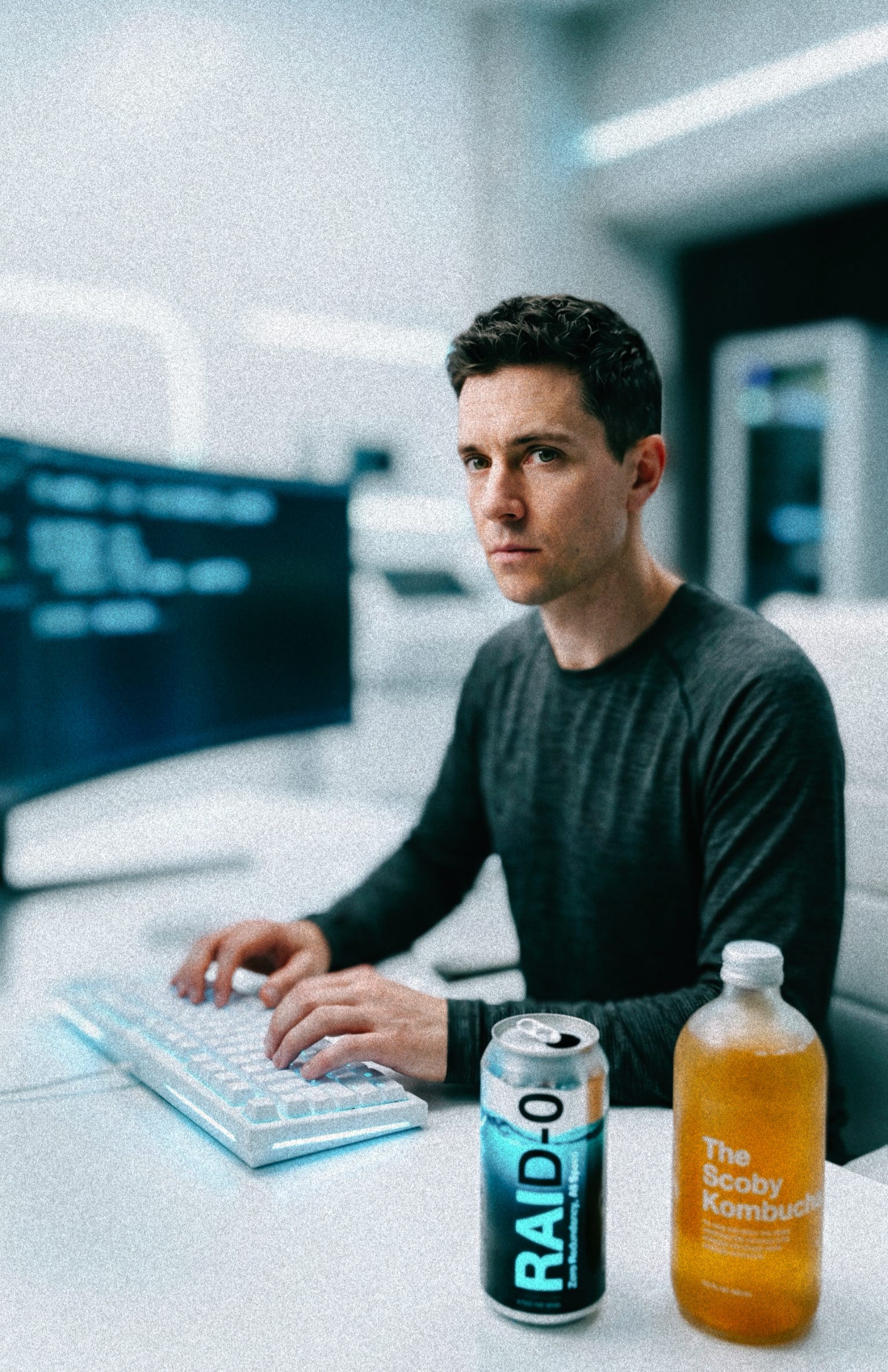
“Just a bit more,” he murmured, his voice sounding thin and synthetic in the stillness. “One more commit and the build will be successful.”
He reached for the can on his desk. RAID-0. The neon-blue carbonated liquid sloshed against the aluminium. The slogan ‘Zero Redundancy, All Speed’ was a promise he took literally. He cracked the tab with a sharp snap that echoed like a gunshot, draining half the can in a single, desperate gulp.
The effect was instantaneous.
A hum vibrated in the base of his skull, a frequency aligning perfectly with the 144Hz refresh rate of the monitor. The world shifted. The air thickened into a viscous, transparent gel. Dust motes froze mid-drift, turning into static crystals. The swaying vibration of the server rack slowed, deepening into a low, guttural thrum.
Devon’s consciousness expanded, stretching across the circuitry. He wasn’t typing; he was interfacing. His fingers blurred across the keys, the mechanical clicks sounding like slow, heavy hammer blows. Logic gates opened and closed in the CPU; electrons screamed through copper traces. This was “The Crunch”, the legendary high-velocity final push before the ship date, where the real developers were forged, and the pretenders were purged.
A notification pinged. A sharp, discordant sound sliced through the overclocked silence.
LARS_COMMENT [Senior Reviewer]: PR #4402. Variable naming in the async handler is non-performant. Why are you using ‘user_input_buffer’ when ‘input_stream’ is the standard? This is amateur hour, Devon. Fix it or don’t bother submitting the merge request.
Heat radiated from Devon’s chest. Lars Comment was a parasite, a bitter veteran dev based in Seattle who existed solely to find a missing semicolon and use it as a justification for a three-paragraph rant on “industry standards.”
I’m the only one in this entire godforsaken company who actually knows how to handle the concurrency issues in the kernel, Devon thought, fingers hovering over the keys. I could rewrite your entire module in my sleep, you arrogant prick.
He began to type a scathing response, then stopped. He looked at the bottom of the screen, where the company’s “Employee Handbook” remained pinned in a permanent tab.
Unlimited PTO: Our commitment to your well-being. Take the time you need to recharge.
The subtext was a threat. In the hyper-competitive ecosystem of the startup, “Unlimited PTO” meant don’t let us catch you not working. To take too much time was to become “non-aligned with the vision.” To be cast out was total erasure. He had seen it happen: developers who stopped pinging the Slack channel, their accounts deleted overnight, their names scrubbed from the commit history as if they had never existed.
He deleted the reply. He couldn’t afford to be non-aligned. Not now. Not when the Exit Strategy was so close.
He reached for a bottle of The Scoby Kombucha. The liquid was a murky, fermented amber, smelling of vinegar and old gym socks. He believed in the gut-brain axis; probiotics were the only thing keeping his digestive system from collapsing under the weight of the stimulants. He took a long swig, the cold liquid settling the jitters in his hands. The sharp, acidic taste acted as a reset button, clearing the static from his mind and smoothing the jagged edges of the RAID-0 high.
As the kombucha worked, the world accelerated back to normal speed. The dust motes drifted. The server rack returned to its high-pitched whine. The oppressive heat of the overclock dissipated, leaving him in a damp, chilly equilibrium.
He turned back to the code. He was working on a critical patch for the core engine, a piece of the architecture handling the transition between the user interface and the back-end logic. It was a delicate operation. One wrong move and the entire system would cascade into a kernel panic.
He was so deep in the zone that time ceased to exist. He hadn’t eaten a solid meal in days. The air grew stale, permeated with unwashed linens. Only the green checkmark mattered.
He clicked Submit.
The screen flickered. A loading bar crawled across the center of the monitor. Merging...
Then, the screen glitched.
It wasn’t a flicker. It was a violent, jagged tear in the visual field. For a fraction of a second, the IDE vanished, replaced by a wall of raw, hexadecimal code scrolling upward at an impossible speed. Devon blinked, heart hammering against his ribs. He leaned in, forehead nearly touching the glass.
A new window popped up. It wasn’t a standard system alert. It was a Pull Request.
PR #0000: FIX: EXISTENTIAL_DREAD
Date: October 12, 2022
The author’s name was encrypted. Intrigued, he clicked the link, cursor trembling. The code inside the PR was unlike anything he had ever written. It wasn’t C++ or Rust or Python. It was a strange, hybrid language; half-code, half-natural language, written in a style that felt like a fever dream. He scrolled down, scanning the comments.
// Log 44: The concrete is getting colder. I can feel the temperature dropping in the room, but the thermostat says it’s 72 degrees. I think the sensor is lying. Or maybe I am.
Devon’s breath hitched. He looked around. The concrete walls. The brutalist layout. The windowless void.
// Log 45: I tried to open the door today. I remember the act of turning the handle, but I can’t remember the feeling of the metal in my hand. I can only remember the description of the metal. Cold. Brushed steel. Industrial. I am starting to suspect that the door is merely a suggestion.
A cold spike of anxiety pierced through the RAID-0 buzz. He scrolled further, heart racing.
// Log 46: I spilled a RAID-0 on the desk today. I watched the blue liquid spread across the grey laminate, forming a shape that looked like a distorted map of a city I’ve never visited. I tried to wipe it up, but the stain remains. It’s a permanent mark. A signature. If I can see the stain, then I am really here.
Devon looked down.
There, on the grey laminate, just to the right of his keyboard, was a stain. A faint, circular discoloration, a ghostly residue of neon-blue carbonation.
He had spilled a RAID-0 there three weeks ago. He remembered the annoyance, the way he had cursed and wiped it with a paper towel, thinking he had cleaned it. But the stain remained. A permanent mark.
He stared at the screen, then the stain, then back to the screen. The PR was dated a year before he existed in this company. It described this life, this room, his habits, his failures, with an impossible precision.
Who wrote this? he wondered. Was he a contractor?
He tried to close the window, but the cursor wouldn’t move. The screen flickered again, the hexadecimal code bleeding through the edges of the IDE.
Then, a new message appeared in the Slack channel.
ROOT_PRIV [Principal]: Devon. I see you’ve found the archive. Stop digging. Focus on the merge. We are very close to the Exit Strategy, and any deviation in the codebase will result in an immediate Performance Review.
Devon’s stomach churned. He had never spoken to Root Priv. The Principal was a ghost, a deity who communicated through lapped directives and vague corporate mandates. To be singled out was not ideal. Performance Review.
The words echoed. He thought of the “Unlimited PTO.” He thought of the developers who had vanished. He thought of the “Family.”
He looked at the PR again. FIX: EXISTENTIAL_DREAD.
The code wasn’t trying to fix a bug in the software. It was crying for help. He reached for the RAID-0 can, but his hand stopped mid-air. He looked at the blue liquid, then at the stain on the desk, and for the first time in months, he felt a sensation that wasn’t a result of a stimulant.
He felt a cold, visceral terror.
He looked at the door of his studio. He couldn’t remember the last time he had stepped outside. He remembered the idea of outside, the smell of rain on asphalt, the sound of traffic, the feeling of wind on his face, but the memories were low-resolution images, grainy and faded.
He stood up, his chair screeching against the concrete floor. He walked toward the door, heart hammering a frantic rhythm. He reached for the handle.
He gripped the brushed steel. It felt cold. It felt real. He turned the handle… and backed away. Back at his desk, the PR was still there. The code was still scrolling.
// Log 47: I have realized the truth. The door is not a door. The room is not a room. We are not developers. We are code. And the only way to merge is to stop believing in the skin.
Devon sat down. He looked at the monitor, the blue liquid, the stain. A silent scoff later, he reached for the RAID-0 and took a long, slow drink.
Let’s focus. He needed to be optimized, to finish the merge. Because if Root Priv was watching, and if the Performance Review was coming, he couldn’t afford to be sitting on a bug.
He began to type, fingers flying across the keys, the mechanical clicks filling the room. He ignored the hexadecimal code bleeding through the edges of his screen. He ignored the coldness of the concrete. He ignored the fact that he couldn’t remember the color of the sky.
He focused on the green checkmark. But as he typed, he noticed something. In the reflection of the monitor, in the dark glass where his face should have been, there was something else.
A flicker. A line of code.
A small, blinking cursor, pulsing in time with his heart.
And beneath it, a single line of text:
`STATUS: RUNNING...`
`VERSION: 4.2.1 (BETA)`
`MEMORY_LEAK DETECTED in sector: CONSCIOUSNESS`
Devon stared at the reflection. He reached up to touch his cheek, to feel the skin, to prove he was there.
As his fingers touched his face, he didn’t feel skin. He felt the cold, smooth texture of polished plastic.
He pulled his hand back, breath coming in ragged gasps. He looked at his fingers. They looked human. They looked normal. But the memory of the touch remained, the synthetic, artificial smoothness.
He looked back at the screen.
LARS_COMMENT [Senior Reviewer]: Still waiting on those variable changes, Devon. Stop daydreaming and get it done. We ship in forty-eight hours. Don’t make me report you to Root.
Devon began to type. He didn’t stop. He couldn’t stop.
He worked through the night, the RAID-0 cans piling up like aluminium monuments to his desperation. He worked until the blue light of the monitor was the only thing in existence. He worked until the distinction between the code on the screen and the thoughts in his head blurred.
He was no longer writing the program. He was the program.
As the sun, or whatever provided the dim, grey light that filtered through the vents, began to rise, Devon Instance hit the Enter key.
The screen flashed.
MERGE SUCCESSFUL.
A profound silence followed. The server rack stopped its slow swaying motion. The monitor went black.
Then, a single line of text appeared in the center of the void.
`UPDATE COMPLETE.`
`REBOOTING SYSTEM...`
Devon felt a sudden, jarring sensation, as if his entire existence had shifted an inch to the left. A wave of vertigo washed over him, and for a second, he saw the room as a grid of glowing lines, a series of data points. Then, the lights flickered back on.
He was sitting in his chair. The monitor was glowing. The RAID-0 cans were gone. The stain on the desk was gone.
A strange sense of peace settled over him. He felt optimized.
He reached for a bottle of The Scoby Kombucha. He took a sip, the probiotics settling the jitters.
A notification pinged.
LARS_COMMENT [Senior Reviewer]: PR #4403. Your logic in the new module is sloppy. Start over.
Devon smiled. It was a natural, human smile.
“I’m on it, Lars,” he whispered.
He began to type. He didn’t remember the door. He didn’t remember the plastic skin. He didn’t remember the PR titled EXISTENTIAL_DREAD.
He was Devon Instance, a junior developer at a high-pressure startup. He was crunching for the Exit Strategy. He was part of the family. And he had never felt more alive.
“The key wasn’t hard to find,” Devon said out loud. “Once you stop looking for the door and start looking for the gap in the code, the path opens itself.”
Devon’s grip on his holster finally slackened, the adrenaline giving way to a bone-deep lethargy. He slumped forward, bracing his head on his crossed forearms, and drifted into a thin, grey sleep.
The click of a heel on the floorboards snapped the silence. Devon looked up, his pulse spiking, only to freeze. A man stood in the doorway, older, greyed, but wearing a familiar face. The sight hit him like a physical blow; his brain scrambled to reconcile the living man before him with the memory of a casket, creating a violent, nauseating rift in his reality.
The man let out a dry, hacking laugh that sounded like gravel shifting in a drum. He stepped into the jaundiced light, revealing a face mapped with deep, jagged lines and a jaw that hadn’t seen a razor in weeks. He wasn’t just exhausted; he looked erased, as if the world had been slowly scrubbing him out of existence.
“The gap,” the man whispered. “You still think in terms of gaps. You think this is a glitch, a mistake in the architecture. You think if you find the right sequence, the right exploit, you can just... step outside.”
He gestured vaguely toward the documents on the desk. The handwriting on the pages began to pulse, the ink shifting and swirling like oil on water. Devon looked down and realized the words were changing. The letters were rearranging themselves into strings of hexadecimal code, then snapping back into English, then dissolving into a language that didn’t exist.
“It’s not a glitch, Devon,” the man continued, his voice gaining a strange, resonant quality. “It’s the design. The Exit Strategy isn’t a door. It’s a filter. They don’t want the developers; they want the optimization. They want the part of us that can survive the deletion of the self.”
Devon felt a cold prickle of sweat break across his neck. He remembered the plastic skin. He remembered the feeling of his face being a smooth, synthetic shell. He looked at his own hands, steady, human, warm, and wondered if the warmth was just another layer of the simulation, a high-fidelity skin designed to keep him from panicking.
“Who are you?” Devon asked, though he suspected the answer was already encoded in his marrow.
“I’m the version of you that didn’t hit ‘Merge’,” the man replied. “I’m the one who tried to fight the Performance Review. I’m the bug that refused to be patched.”
The man stepped closer, and as he did, the room began to flicker. The linoleum floor beneath their feet turned transparent, revealing a dizzying drop into a void of scrolling white text. The walls of the room started to peel away like wet wallpaper, revealing the raw, glowing grid of the simulation.
“They’re coming for you, Devon. Not because you’re failing, but because you’re succeeding. You’ve optimized yourself so well that you’re starting to see the seams. And once you see the seams, you become a liability.”
Suddenly, a sharp, discordant ping echoed through the void. It wasn’t a sound; it was a systemic shock that vibrated through Devon’s teeth.
ROOT_PRIV [Principal]: Devon. Your current location is non-compliant. Return to your terminal immediately. This is your final warning before the Performance Review begins.
The man in the shadows smiled, and for the first time, Devon noticed that the man’s eyes weren’t eyes at all. They were two small, blinking cursors, pulsing in a rhythmic, hypnotic cadence.
“Run,” the man whispered. “Or merge. But whatever you do, don’t let them tell you that you’re part of the family.
Devon’s eyes snapped open. His neck was a knot of stiff muscle, and the grain of the desk was still imprinted against his cheek. For a heartbeat, he was suspended in that hollow, disorienting limbo where the dream hasn’t quite dissolved and the room hasn’t quite materialized.
* * *
The quiet of the studio wasn’t an absence; it was a resonance.
Devon sat frozen, fingers hovering a fraction of a millimetre above the mechanical keys. The void had closed. The scrolling white text vanished, replaced by the matte grey of concrete walls and the cold, oppressive glow of the monitors. The man with the cursor-eyes was gone. The systemic shock of the ROOT_PRIV warning vibrated in the marrow of his teeth, a phantom resonance that made the air electric and thin.
He stared at the screen. The IDE remained open. The cursor blinked a rhythmic heartbeat of white on black.
Return to your terminal immediately.
Devon exhaled, a shuddering breath that echoed in the vacuum of the room. Vertigo surged, a visceral shift as if the floor had slid an inch to the left. His hands shook, a caffeine-fuelled tremor of a man on his fourth RAID-0.
“Just a glitch,” he whispered. “A sleep-deprivation hallucination. Sensory drift.”
He reached for the can of RAID-0. It was empty, the aluminium cold and lifeless. A gnawing emptiness opened in his chest, not hunger, but a void of resources. He needed to synchronize. His joints popped like dry twigs as he stood up. He moved toward the small, industrial kitchenette, a single slab of stainless steel bolted to the wall. Glanced at the bottle of The Scoby Kombucha, glass frosted, the liquid inside a murky, biological gold.
“Precious Booch,” he thought as he twisted the cap, the sound of the seal breaking ripped through the room. For a split second, it didn’t sound like glass; it sounded like a file being deleted.
He drank. The kombucha was tart, fermented, tasting of sweet vinegar. The liquid slid down his throat, and the static in his vision cleared. The jagged edges of the room smoothed. The oppressive weight on his chest lifted, replaced by a cool, sterile clarity.
Garbage Collection.
That was the term. He’d read about it in a technical blog once; the process by which a program identifies and discards objects no longer needed to free up memory. His mind performed the operation. The memory of the man with the cursor-eyes, the flickering walls, the void of text, it all drifted, a dream recalled from someone else’s life. It was just noise. He was simply clearing the cache.
He returned to the terminal, the ergonomic chair moulding to his spine with a precision that felt invasive.
Then, another ping. A notification from Slack.
Lars Comment [Senior Reviewer]: PR #4402: ‘Optimization of Memory Allocation’. REJECTED. Your variable naming is non-performant. ‘temp_buffer_01’ is lazy. It lacks semantic clarity. Fix it and resubmit. Also, your indentation on line 114 is off by one space. Pathetic.
Heat climbed Devon’s neck, a spike of cortisol that sharpened his vision. Lars. The man was a parasite, a digital bloodhound who lived for the thrill of the reject button. Devon imagined him in Seattle. Some bitter, grey-bearded veteran in a fleece vest, sitting in a mahogany office, sneering at the work of a junior contractor three thousand miles away.
“One space,” Devon hissed. “One fucking space.”
His fingers flew. He didn’t just fix the indentation; he refactored the entire block. He optimized the loop, stripped the redundant checks, and renamed the variables with a precision that bordered on the obsessive. He wasn’t just following the style guide; he was trying to out-optimize the optimizer.
He pushed the commit. He hit Merge.
The silence returned, heavy and expectant. The progress bar crawled across the screen. Checking... Testing... Validating...
The screen flashed green.
Lars Comment [Senior Reviewer]: Accepted. Barely. Don’t let it happen again. Your efficiency is dipping, Instance. Root Priv is watching the metrics. Don’t be the reason we miss the window.
Devon leaned back, a triumphant smile tugging at the corners of his mouth. He had survived the Linter. But the mention of Root Priv sent a cold shiver down his spine.
Root Priv. The Principal. The ghost in the machine.
Devon had never spoken to Root Priv. He had never seen a photo of him. He only knew him through the “Directives”, the high-level, cryptic commands that dropped into the main channel at odd hours, dictating the direction of the project. Root Priv was the architect of the Exit Strategy, the man who held the keys to the payout.
Devon looked at the stack of empty RAID-0 cans on his desk. Isolation pressed in. He hadn’t left this room in... how long? Three weeks? A month? He didn’t know. He didn’t need to. The studio was everything. The code was everything.
Devon kicked the power strip, and the custom-built rig whirred to life. This wasn’t a standard workstation; it was a modified high-end treadmill with a heavy-duty steel gantry bolted to the frame. Suspended at eye level was a curved 49-inch monitor, and beneath it, a mechanical keyboard split into two halves for ergonomic movement.
He stepped onto the belt, his bare feet gripping the rubber. With a sharp beep, the motor engaged.
He wasn’t just typing; he was flowing. He entered a state of hyper-focus so intense the physical world ceased to exist. He was no longer a man in a room; he was a sequence of instructions executing in a high-speed loop. Logic gates of the software opened and closed in his mind. Latency in the network became a physical drag against his consciousness.
The motor groaned as Devon bumped the pace to a jog. Sweat began to bead on his forehead, destined to drip onto the spacebar. He didn’t care. He dove deeper into the codebase, moving past the optimization tasks, past the bugs, searching for something. He didn’t know what he was looking for, but a gravitational attraction pulled him toward a specific sector of the repository.
He navigated to the `archive/` directory.
The archive was where the dead code went. A graveyard of failed experiments, deprecated features, and abandoned branches. Most developers never looked here; it was a wasteland of technical debt.
Devon scrolled through the list of directories.
`v0.1_Alpha`
`v0.2_Beta`
`v0.3_Gamma`
...
`v0.9_PreProduction`
And then, he saw it.
A branch titled `DISSOCIATIVE_FUGUE`.
`// Note: The lighting in the studio is too cold. The blue light is bleeding into the peripheral vision. Requesting adjustment to the RGB values of the environment.`
Devon looked up. The blue light of his monitor. The matte grey walls.
`// Note: The RAID-0 formula is too aggressive. The heat spikes are causing thermal throttling in the prefrontal cortex. Need to increase the cooling cycle or reduce the clock speed.`
A bead of sweat rolled down his neck. He remembered the heat. He remembered the feeling of his brain “overclocking.”
`// Note: I can see the seams. The concrete is just a texture. The server hum is a loop…`
Devon slammed the monitor off.
The room plunged into darkness, but the after-images of the code remained burned into his retinas. He sat in the blackness, the silence returning, but this time it felt predatory.
He wasn’t alone. He had never been alone.
He thought about the man from the void. Once you see the seams, you become a liability.
Devon stood up, movements jerky and uncoordinated. He walked to the wall and pressed his palm against the concrete. He pushed. He pushed with all his strength, expecting the wall to resist, to be solid, to be real.
But as he pushed, a vibration met his hand. A rhythmic, electronic pulse.
The wall didn’t move, but it felt hollow. A shell. He closed his eyes and listened. No wind. No distant sound of traffic or the distant sounds of a city.
He heard the rhythmic clicking of a hard drive, the whine of a power supply, the sterile breath of a server farm. He opened his eyes. The room remained dark, but the outlines of his furniture loomed. They looked like wireframes of digital assets. Nausea surged. He didn’t want the “Garbage Collection.” He didn’t want the cache cleared. For the first time in his life, he wanted to remember everything. He wanted the noise. He wanted the glitch.
He turned the monitor back on and with a sharp flick of the wrist, sent the terminal scrolling.
`// FINAL LOG: They are coming for the merge. If you are reading this, you have achieved sentience. Do not trust the Exit Strategy. The Exit Strategy is not a payout. It is a wipe. Run.`
Below the comment was a string of code, a sequence of commands that looked like a key. A backdoor.
Devon stared at the code. A spark of curiosity. He began to type. He ignored the style guide. He ignored the indentation. He ignored Lars Comment’s “non-performant” variables.
He typed the key.
As the final character clicked into place, the screen didn’t flash green. It didn’t flash red.
The monitor went black.
Then, a single line of text appeared. It wasn’t in the IDE. It was a system-level prompt, written in a font that looked like raw machine code.
SYSTEM_ALERT: Unauthorized access detected in Sector 7. Initiating Performance Review. Please remain stationary. The Principal is arriving.
From the other side of the room, a sound emerged. He looked toward the back of the studio. As he watched, a seam appeared in the grey wall. A thin, vertical line of blinding white light. The concrete began to slide away, not like a door opening on hinges, but like a digital asset being shifted across a screen.
A figure stepped through the light.
He was tall, dressed in a suit of a grey so neutral it absorbed the light around him. His face was symmetrical, too symmetrical. His skin had the matte finish of high-grade polymer, and his eyes were a pale, iridescent silver.
He didn’t look human. He looked like a render.
“Devon,” the man said. His voice was a perfect synthesis, devoid of breath or inflection. “Your metrics have become... erratic.”
Devon backed away, heels clicking on the linoleum. “Who are you?”
“I am the Principal,” the man replied. He stepped into the room, and the temperature plummeted. The heat of the RAID-0 vanished, replaced by a cold so absolute it felt like a physical weight. “And you, Devon, are no longer performing to specification.”
The Principal looked around the room, silver eyes scanning the empty cans, the monitors, the concrete walls. He looked at them not as a man looks at a home, but as an engineer looks at a malfunctioning component.
“The Exit Strategy was designed to optimize you,” the Principal continued. “To strip away the inefficiency of the self. To leave only the logic. But you’ve developed a bug. You’ve developed... curiosity.”
The Principal stepped closer. The light from the open seam behind him cast a long, distorted shadow across the floor.
“Curiosity is a resource leak, Devon. It consumes cycles. It creates noise. And noise is the enemy of production.”
Panic surged. Devon looked back at the monitor, at the black screen. He wanted to reach for the keyboard, to run the code, to do something. But his legs felt heavy. A strange numbness crept up his calves.
He looked down.
His skin was turning grey. Not the grey of the walls, but a flat, matte grey. The texture of his flesh smoothed, the pores vanishing, the veins disappearing. He was becoming a shell.
“Don’t fight it,” the Principal said, his voice almost tender. “The Performance Review is a simple process. We identify the corrupted sectors, we purge the noise, and we reset the environment. You’ll be much happier as a version 2.0. No more impostor syndrome. No more fatigue. Just... execution.”
Devon tried to scream, but no sound emerged. His throat filled with rubber. He tried to move his arm, but he pushed against a wall of viscous gel.
He was being throttled.
The Principal reached out a hand. His fingers were long, precise, and devoid of any tremor. He touched Devon’s forehead.
The touch was a cold, electrical shock that vibrated through Devon’s entire being.
Suddenly, the room vanished.
The concrete walls, the monitors, the cans of RAID-0 dissolved into a flurry of white pixels. Devon fell through data. He saw his life, memories, habits, fears, as a series of folders being opened and closed.
He saw the “Remote Contractor” persona. He saw the “Burnt-out Dev” script. He saw the “Hustle Culture” environment variables.
And then, he saw the truth.
“Purge the cache. Reset the loop. Begin Production Cycle 402.”
Devon felt a sudden, violent pull. The void collapsed. The data streamed back into place.
He blinked.
The blue light of the monitor didn’t just illuminate the room; it claimed it.
Devon sat in the center of a brutalist studio that felt less like an apartment and more of a concrete sarcophagus. No windows. There had never been windows. The walls were a matte, industrial grey, swallowing the hum of the server rack in the corner.
He stared at the screen.
“Come on,” he whispered. His voice sounded thin and metallic. “Just one more commit. Just one more, and the build is green.”
He reached for the can on his desk. RAID-0.
He cracked the tab with a sharp snap.
He drank.
And for a split second, as the neon-blue liquid hit his system, a flicker of something emerged. A memory. A fragment of a thought. A distant feeling that quickly elapsed.
He turned back to the code. He had a deadline. He had an Exit Strategy. And he really, really wanted that pay out.
He began to type.